
FSSAI Food Labelling Rules 2026 | Essential Guide India
FSSAI Food Labelling Rules 2026 are important for food manufacturers, packers, importers, repackers, relabellers, private-label brands, bakeries, food processors and other Food Business Operators (FBOs) selling packaged food in India. Food packaging is not only about attractive design; it must also communicate applicable product information accurately and clearly to consumers.
The Food Safety and Standards Authority of India (FSSAI) regulates food labelling through the Food Safety and Standards framework, including the Food Safety and Standards (Labelling and Display) Regulations, 2020, along with subsequent amendments and applicable directions.
In 2026, FSSAI listed a First Amendment to the Labelling and Display Regulations dated 24 March 2026. Businesses should understand the difference between an amendment being notified and the date from which its provisions become applicable. The 2026 First Amendment specifies 1 July 2027 as its commencement date. Therefore, food businesses should monitor the official FSSAI notifications and review their labels according to the requirements applicable to their products and current compliance date.
This complete guide explains the important food labelling requirements, common packaging mistakes, label review process, online food business considerations and practical compliance tips.
What Are FSSAI Food Labelling Rules?
FSSAI food labelling requirements govern the information that must be provided on applicable pre-packaged food products and, where relevant, the display of essential information at food premises.
The objective is to provide consumers with meaningful product information and reduce the possibility of misleading representation.
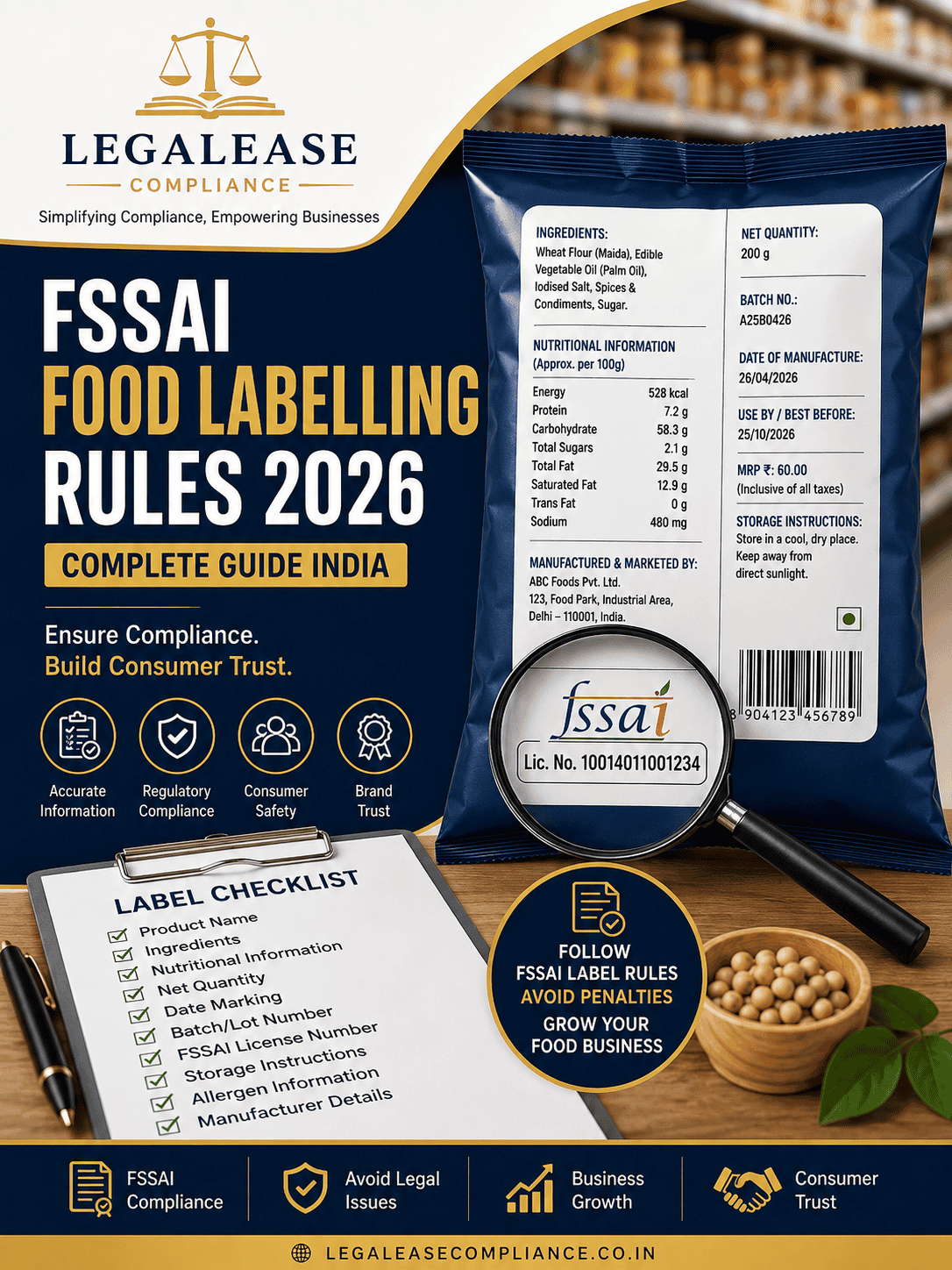
Depending on the product, packaging and applicable regulations, a food label may need information relating to:
Name of the food
List of ingredients
Nutrition information
Net quantity
Date marking
Batch or lot identification
Manufacturer, packer or marketer details
FSSAI licence information
Storage conditions
Instructions for use where applicable
Allergen declarations where applicable
Product-specific declarations
Mandatory warnings or symbols where applicable
Not every food product has exactly the same labelling requirements. Product category, composition, claims, packaging type and applicable regulations should be considered before finalising packaging artwork.
Why Is Food Labelling Compliance Important?
Correct labelling is an important part of food business compliance because the package is often the primary source of information available to consumers before purchase.
A properly reviewed label can help a food business:
Provide accurate product information
Meet applicable regulatory requirements
Reduce avoidable compliance objections
Improve product traceability
Avoid misleading representations
Maintain consistency between records and packaging
Reduce packaging reprinting costs
Build consumer confidence
Support responsible food marketing
Businesses should ideally complete a compliance review before sending large quantities of packaging material for printing.
Who Needs to Follow Food Labelling Requirements?
Food labelling requirements can apply to a wide range of businesses involved in packaged food.
These may include:
Food manufacturers
Food processors
Food packers
Repackers
Relabellers
Food importers
Private-label food brands
Bakeries
Snack manufacturers
Sweet manufacturers
Beverage companies
Packaged food retailers
D2C food brands
Cloud kitchens selling packaged food
Online food businesses
Food wholesalers
If a third-party manufacturer produces food for your brand, you should not automatically assume that the label is compliant. The brand owner should ensure that the final packaging information is appropriate for the product and business arrangement.
Important Information to Check on a Food Label
A food business should carefully review every relevant declaration before approving its packaging artwork.
1. Name of the Food
The name or description of the food should accurately communicate the nature of the product.
The presentation should not create a misleading impression about the product’s composition, identity or characteristics.
2. Ingredients List
The ingredients should be declared as required for the applicable product.
Businesses should compare the label with the actual formulation and verify relevant requirements relating to:
Ingredient names
Order of ingredients where applicable
Compound ingredients where applicable
Allergen information
Percentage declarations where required
Product-specific ingredient requirements
The final printed label should match the actual product formulation.
3. Nutrition Information
Where nutrition declaration is applicable, the information should be prepared and displayed according to the relevant requirements.
Businesses should avoid copying nutrition information from another product simply because the products appear similar.
Nutrition information should relate to the actual food product and should be reviewed before printing.
4. Net Quantity
The package should display the applicable net quantity declaration.
Businesses should verify that the declared quantity corresponds with the actual contents and applicable measurement requirements.
5. Date Marking
Date-related declarations should be reviewed carefully.
Depending on the product and applicable requirements, businesses may need appropriate date information such as best-before or expiry-related declarations.
The date printed on the final package should be clear and consistent with the applicable requirements.
6. Batch or Lot Identification
Where applicable, the product should carry an appropriate batch, lot or identification code.
Batch information is important for traceability, quality control and product identification.
7. Manufacturer, Packer or Marketer Details
The applicable business name and address information should be checked carefully.
The packaging information should be consistent with the relevant business records and licensing information.
8. FSSAI Licence Information
Food businesses should verify that the applicable FSSAI licence information is correctly represented on the product packaging.
Do not use an old licence number or information belonging to another business.
9. Storage Instructions
Where applicable, storage instructions should be clearly provided.
Some food products may require specific storage conditions to maintain quality and safety.
If storage conditions change after opening, appropriate instructions should also be considered where applicable.
10. Instructions for Use
Certain food products may require preparation, handling or usage instructions.
Businesses should determine whether such information is applicable to their specific product and category.
FSSAI Food Labelling Rules 2026: Common Mistakes to Avoid
Understanding the requirements is only the first step. Many food businesses face problems because of simple packaging mistakes.
Mistake 1: Using an Old Packaging Design
A business may continue using an old label because the packaging was previously approved internally.
However, businesses should periodically review packaging against the latest applicable regulatory requirements and product-specific provisions.
Mistake 2: Copying a Competitor’s Label
A competitor’s packaging should never be treated as a compliance template.
Two similar-looking products can have different ingredients, claims, formulations, categories and regulatory requirements.
Mistake 3: Incorrect FSSAI Information
Incorrect or outdated FSSAI licence information can create avoidable compliance issues.
Always verify the relevant details before printing.
Mistake 4: Unsupported Product Claims
Marketing claims require careful review.
Examples of claims that may require particular attention include:
Natural
Healthy
Organic
Sugar-free
No added sugar
High protein
Immunity
Premium
Low fat
Gluten-free
A business should not use a claim simply because it sounds attractive. The claim should be appropriate, accurate and supported under the applicable regulatory framework.
Mistake 5: Ignoring Product-Specific Requirements
A generic food label template cannot automatically be used for every product.
Product category and applicable regulations should be checked before packaging approval.
Mistake 6: Printing Thousands of Packages Before Review
This can be an expensive mistake.
If incorrect information is discovered after mass printing, the business may face packaging replacement or reprinting costs.
A pre-printing compliance review can reduce this risk.
How to Check Your Food Label Before Printing
Use this simple process before approving packaging artwork.
Step 1: Identify the Product
Clearly identify the food product, its formulation and applicable category.
Step 2: Check the FSSAI Licence
Verify the business licence information and ensure that the relevant business activity and product details are consistent with your records.
Step 3: Compare the Ingredients
Compare the ingredient list printed on the packaging with the actual product formulation.
Step 4: Review Mandatory Declarations
Check applicable information relating to:
Product name
Ingredients
Nutrition information
Net quantity
Date marking
Batch or lot information
Manufacturer details
FSSAI information
Storage instructions
Applicable warnings
Other product-specific declarations
Step 5: Review Marketing Claims
Check every promotional statement appearing on the packaging.
Do not assume that a marketing phrase is acceptable simply because other brands use similar wording.
Step 6: Check the Artwork
Review the visibility, readability and placement of mandatory information.
Important information should not be hidden by design elements, folds, seals or other packaging features.
Step 7: Final Approval
Complete the compliance review before sending the final artwork for large-scale printing.
FSSAI Packaging and Labelling for Online Food Businesses
Online food businesses have an additional responsibility to keep their digital product information consistent with their physical packaging.
If you sell packaged food through:
Your website
Amazon
Flipkart
Other marketplaces
Social media
Food-delivery platforms
review the information shown online.
Check consistency between:
Product packaging
Product title
Product description
Ingredients
Nutrition information
Product photographs
Product claims
FSSAI information
A customer should not receive a product whose packaging materially conflicts with the information presented online.
FSSAI Food Labelling Rules 2026 Checklist
Before printing or launching a packaged food product, businesses can use the following checklist:
Product category identified
FSSAI licence information verified
Product name reviewed
Ingredients checked
Nutrition information reviewed where applicable
Net quantity checked
Date marking reviewed
Batch or lot information checked
Manufacturer or marketer details verified
Storage instructions checked
Applicable warnings reviewed
Product claims reviewed
Packaging artwork checked
Online product information reviewed
Final compliance review completed
This checklist can help businesses identify common gaps before packaging reaches the printing stage.
What Changed in 2026?
FSSAI’s official records list a First Amendment to the Food Safety and Standards (Labelling and Display) Regulations, 2020, dated 24 March 2026.
The amendment includes provisions relating to exemptions concerning Recommended Dietary Allowance (RDA) information for certain categories, including infant nutrition products and non-retail containers. The notification specifies that the amendment will come into force on 1 July 2027.
This is important because businesses should distinguish between:
Notification date: when the amendment is officially notified.
Commencement date: when the amended provision becomes applicable.
Therefore, businesses should not assume that every amendment published in 2026 automatically becomes enforceable immediately.
For product-specific compliance, businesses should check the official notification and applicable regulations before changing packaging.
Why Businesses Should Review Their Labels Regularly
Food businesses often update:
Product formulation
Ingredients
Packaging
Suppliers
Product size
Marketing claims
Manufacturer arrangements
FSSAI licence details
Any such change can affect packaging information.
A regular review helps businesses identify outdated information before it becomes a regulatory or commercial problem.
For businesses with multiple products, each product label should be reviewed separately.
FSSAI Compliance Services in Delhi NCR
Food businesses operating in Delhi NCR should maintain accurate FSSAI records and review their product documentation and packaging regularly.
LegalEase Compliance – Shailputri Enterprises provides compliance consultancy support for businesses in:
Delhi
Noida
Greater Noida
Ghaziabad
Gurugram
Faridabad
Our FSSAI-related consultancy services include:
FSSAI Registration
FSSAI State Licence
FSSAI Central Licence
FSSAI Renewal
FSSAI Modification
Food Business Compliance
Documentation Support
Label Compliance Review
Regulatory Consultancy
If you are starting a food business, you can also read our detailed guide:
FSSAI New Rules 2026 – Everything Food Business Owners Need to Know
This article covers broader FSSAI compliance topics and can be used together with this detailed labelling guide.
Internal Linking Strategy
For better website navigation and topical SEO, add internal links to relevant LegalEase Compliance pages.
Recommended anchor texts include:
FSSAI Registration
FSSAI Licence
FSSAI Renewal
GST Registration
MSME Registration
MCD Trade Licence
Fire NOC Consultancy
Building Plan Approval
Compliance Audit
Contact LegalEase Compliance
Link to Your Existing FSSAI Article
Add this internal link naturally:
FSSAI New Rules 2026 – Everything Food Business Owners Need to Know
URL:
https://legaleasecompliance.co.in/fssai-new-rules-2026-everything-food-business-owners-need-to-know/
This creates a useful connection between your broader FSSAI article and this specialised labelling article.
Frequently Asked Questions
What are FSSAI Food Labelling Rules 2026?
FSSAI Food Labelling Rules 2026 refer to the applicable food labelling requirements under India’s Food Safety and Standards framework, including the Labelling and Display Regulations, amendments and relevant directions.
Is food labelling mandatory for packaged food?
Applicable packaged food products must comply with the relevant labelling requirements. The exact information required depends on the product, category, packaging and applicable regulations.
Can I continue using old food packaging?
Businesses should review existing packaging against the latest applicable requirements before continuing production. Do not assume that an old label remains compliant simply because it was previously used.
What information should appear on a food label?
Depending on the product, applicable information can include the food name, ingredients, nutrition information, net quantity, date marking, batch or lot details, manufacturer information, FSSAI information and other applicable declarations.
Can food businesses use health-related claims?
Claims should be reviewed carefully against the applicable requirements. Businesses should avoid unsupported or misleading claims.
Do online food businesses need to check their labels?
Yes. Online product information should be consistent with the actual packaged product and should not create a misleading impression.
Should every product label be reviewed separately?
Yes. Different products can have different formulations, categories, claims and regulatory requirements. A single generic label template should not automatically be applied to every product.
Can LegalEase Compliance help with FSSAI labelling compliance?
LegalEase Compliance provides FSSAI registration, licensing and food compliance consultancy, including documentation and label review support for businesses.
Conclusion
FSSAI Food Labelling Rules 2026 are an important part of responsible food business compliance in India. A food label is more than a marketing design—it provides consumers with important information about the product and supports regulatory compliance.
Food manufacturers, packers, repackers, relabellers, importers, private-label brands and other Food Business Operators should review their packaging carefully before printing new stock.
Businesses should also monitor official FSSAI notifications because amendments may have different notification and commencement dates.
A professional label review can help identify incorrect information, outdated declarations, unsupported claims and other potential compliance gaps before they become costly problems.
For FSSAI registration, licensing, renewal, modification and food compliance consultancy in Delhi NCR, LegalEase Compliance – Shailputri Enterprises can assist businesses with documentation and regulatory compliance support.
Important Disclaimer
Food regulations and applicable requirements can change. This article is for general educational information and should not be treated as legal advice. Always verify the latest applicable FSSAI notification, regulation, direction and product-specific requirement before finalising commercial food packaging.
LegalEase Compliance – Shailputri Enterprises
Delhi NCR | FSSAI & Business Compliance Consultancy