
Delhi Ease of Doing Business Bill 2026: New Rules & Reforms
Last Updated: August 2026
Delhi is moving towards a more streamlined and business-friendly regulatory system. The Delhi Ease of Doing Business Bill 2026 is a proposed legislative framework aimed at simplifying business approvals, reducing unnecessary compliance procedures and improving the way businesses interact with government departments.
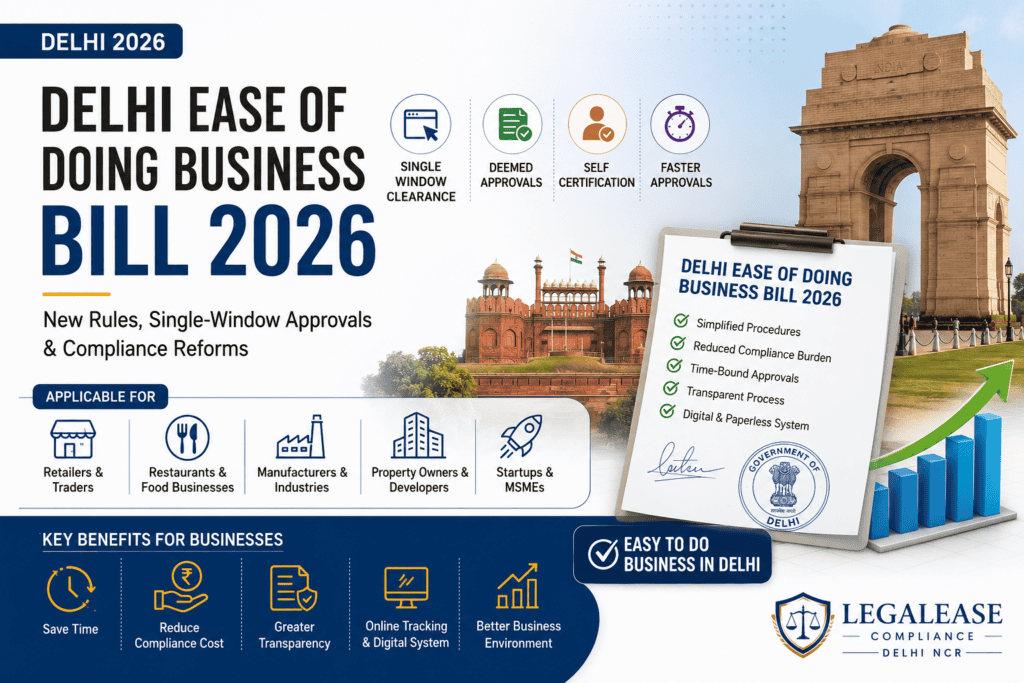
The Delhi Cabinet approved the draft Bill in August 2026. Reported proposals include single-window clearances, self-certification for eligible low-risk businesses, deemed approvals in specified cases and reduced routine inspections.
For entrepreneurs, traders, manufacturers, restaurants, startups, property owners and MSMEs, these proposed reforms could make government approval processes more predictable and digitally accessible.
However, businesses should understand one important point: the draft Bill does not automatically remove every licence, registration or NOC currently required in Delhi. Businesses should continue following existing requirements until the final legislation, rules and departmental notifications are officially implemented.
What Is the Delhi Ease of Doing Business Bill 2026?
The Delhi Ease of Doing Business Bill 2026 is a proposed reform intended to simplify the regulatory environment for businesses operating in the National Capital Territory of Delhi.
The proposed framework focuses on reducing unnecessary procedural delays and making government approvals more transparent and technology-driven.
The major proposals reported so far include:
- Single-window approval system
- Deemed approvals for specified services
- Self-certification for eligible low-risk industries
- Reduction in routine inspections
- Digitisation of approval processes
- Time-bound government services
- Simplification of business compliance
- Reduction of repetitive documentation
The proposals are part of a wider Ease of Doing Business reform approach that focuses on reducing compliance burden and improving the predictability of government processes.
Why Is the Delhi Ease of Doing Business Bill 2026 Important?
Starting and operating a business in Delhi can involve several departments and authorities.
Depending on the business activity and premises, an entrepreneur may need to deal with:
- Municipal Corporation of Delhi
- NDMC
- Delhi Development Authority
- Delhi Fire Service
- Delhi Jal Board
- Delhi Pollution Control Committee
- Labour Department
- FSSAI
- GST authorities
- Factory and industrial authorities
- Other regulatory departments
The proposed reforms aim to make these interactions easier by moving towards integrated digital systems and more predictable approval procedures.
Delhi already operates a Single Window System that provides businesses with access to multiple departments and approval services. The official portal describes it as an integrated service-delivery platform intended to provide time-bound clearances and reduce repetitive documentation.
Key Features of the Delhi Ease of Doing Business Bill 2026
1. Single-Window Clearance System
One of the most important elements of the proposed Delhi Ease of Doing Business Bill 2026 is the strengthening of the single-window approval system.
Delhi’s existing Single Window System allows businesses to identify required approvals and apply for services through an integrated platform.
The official Delhi portal currently lists services involving departments and authorities including:
- DDA
- Delhi Fire Service
- Delhi Jal Board
- MCD
- Labour Department
- Delhi Pollution Control Committee
- Revenue Department
- Transport Department
- Other government agencies
Delhi Single Window System – Government of Delhi
What Could This Mean for Businesses?
A stronger single-window system could help businesses:
- Identify applicable approvals
- Submit applications online
- Upload documents digitally
- Track application status
- Reduce repetitive paperwork
- Reduce unnecessary physical visits
- Improve transparency
- Follow application timelines
The exact services covered by the proposed Bill will depend on its final legislation and implementation rules.
2. Deemed Approvals
Another important proposal is the use of deemed approvals for specified government services.
In a deemed-approval system, an application may be treated as approved if the competent authority does not take a decision within the prescribed period, subject to the conditions and exceptions provided by the applicable law.
The objective is to reduce delays and provide businesses with greater certainty.
However, businesses should not assume that every government application will automatically receive deemed approval.
Important
Deemed approval will apply only where the final law, rules or notification specifically provides for it.
Until the relevant provisions are officially implemented, businesses should continue following the existing approval process.
3. Self-Certification for Low-Risk Businesses
The proposed Bill also provides for self-certification for eligible low-risk industries.
This reflects a shift towards risk-based regulation.
Instead of applying the same inspection approach to every business, government departments can potentially classify businesses according to their level of regulatory risk.
For eligible low-risk businesses, self-certification could reduce unnecessary administrative procedures.
However, self-certification does not mean that a business can ignore applicable laws.
Businesses would still be responsible for:
- Providing accurate information
- Maintaining required records
- Following safety requirements
- Meeting statutory standards
- Producing documents when required
- Cooperating with lawful verification or inspection
4. Reduction in Routine Inspections
The draft Delhi Ease of Doing Business Bill 2026 also proposes reducing routine inspections in specified situations.
Current reports indicate that newly registered enterprises may receive relief from routine inspections for a specified period, subject to the final framework and applicable exceptions.
This could particularly help:
- Startups
- MSMEs
- Low-risk industries
- New enterprises
- Small businesses
The objective is to allow businesses to focus on operations while maintaining necessary regulatory safeguards.
5. Faster and More Transparent Approvals
Another major objective is to make government approval processes more predictable.
Delhi’s existing Single Window System already provides features such as:
- Online applications
- Common Application Form
- Defined processing timeframes
- Online fee payment
- Central Inspection System
- Application tracking
- Grievance mechanisms
- Alerts and notifications
Delhi Single Window – One Stop Information
The proposed Bill could further strengthen this approach.
How Could the Bill Affect MCD Trade Licence?
MCD Trade Licence is one of the important compliance areas for businesses operating in Delhi.
Retailers, traders, shops and other commercial establishments may have municipal requirements depending on their business activity, premises and applicable regulations.
The proposed reforms could make municipal approval procedures more streamlined, but businesses should not assume that MCD Trade Licence requirements have been abolished.
Before starting or changing a business, check:
- Business activity
- Premises use
- Applicable municipal category
- Property documentation
- Fire requirements
- Food licence requirements, where applicable
- Signage requirements
- Health and sanitation requirements
For professional assistance, you can internally link this section to your:
MCD Trade Licence services in Delhi NCR
Suggested anchor text: MCD Trade Licence services in Delhi NCR
How Could the Bill Affect Building Plan Approval?
Building approval is another important compliance area for Delhi businesses and property owners.
Depending on the property and jurisdiction, building-related permissions can involve MCD, DDA or NDMC and may require additional NOCs.
Your website already provides a dedicated:
Building Plan Approval Consultancy Services in Delhi NCR
This service covers building plan approval, DDA plan sanction, MCD approval, NDMC approval, completion certificate and occupation certificate support.
Important for Property Owners
The Ease of Doing Business reforms should not be interpreted as permission to start construction without approval.
Before construction, renovation or change of use, property owners should determine:
- Correct approving authority
- Land use
- Building regulations
- FAR
- Setbacks
- Height restrictions
- Parking requirements
- Fire requirements
- Other applicable NOCs
Fire NOC and Safety Compliance
Businesses should be particularly careful about Fire NOC requirements.
Restaurants, hotels, factories, commercial buildings, schools, hospitals and other regulated premises may have specific fire-safety requirements.
The proposed Delhi Ease of Doing Business Bill 2026 is intended to simplify administrative processes. It should not be interpreted as a blanket exemption from fire-safety obligations.
Your relevant internal service page is:
Delhi Fire Service NOC & Fire Safety Compliance
Businesses should continue maintaining applicable:
- Fire safety systems
- Emergency exits
- Fire equipment
- Safety certificates
- Inspection records
- Required NOCs
The exact requirements depend on the building type, occupancy and applicable regulations.
FSSAI Compliance for Food Businesses
Restaurants, cloud kitchens, bakeries, caterers, food manufacturers and other food businesses should also understand that general Delhi business reforms do not automatically replace food-safety regulations.
FSSAI continues to publish amendments and regulatory notifications during 2026.
Therefore, food businesses should continue checking their applicable:
- FSSAI Registration
- State Licence
- Central Licence
- Renewal requirements
- Food safety documentation
- Applicable inspection requirements
For your internal linking, use:
FSSAI Food Licence services
and link it to the relevant FSSAI service page on your website.
If the exact FSSAI URL is not currently active, do not create a fake URL. Link to the service page from your WordPress editor after confirming the current page URL.
Property Compliance and the New Business Environment
Property owners and commercial establishments can also benefit from a more integrated compliance approach.
For example, a commercial property may involve:
- Property documentation
- DDA requirements
- MCD requirements
- Fire NOC
- DJB requirements
- Building plan approval
- Completion certificate
- Occupancy certificate
- Property tax clearance
Your existing:
Property Compliance Consultancy Delhi NCR
covers areas including NOC procurement, property documentation, encumbrance certificates and registry assistance.
This makes the article naturally connected to your commercial property compliance service.
What Does the Bill Mean for MSMEs and Startups?
The proposed reforms could be particularly useful for MSMEs and startups because smaller businesses often have limited resources for handling complex administrative procedures.
Potential benefits include:
Reduced paperwork
Digital systems can reduce repetitive documentation.
Better tracking
Online systems can make application status easier to monitor.
Faster decisions
Time-bound processes can reduce uncertainty.
Lower administrative burden
Self-certification and risk-based inspections may reduce unnecessary procedures for eligible businesses.
Better transparency
Online applications and tracking can provide clearer records.
However, the actual benefit will depend on how the final law and departmental rules are implemented.
Does the Delhi Ease of Doing Business Bill 2026 Remove All Licences?
No.
This is one of the most important points for business owners.
The proposed Bill is about simplifying and streamlining compliance, not automatically eliminating every licence or registration.
For example:
| Business Type | Possible Compliance Areas |
|---|---|
| Restaurant | MCD/NDMC, FSSAI, Fire Safety, GST and others |
| Factory | Factory, Labour, Fire, Pollution, GST and others |
| Retail Shop | Municipal, GST and other applicable requirements |
| Hotel | Fire, FSSAI, municipal and other requirements |
| Commercial Building | Building approval, Fire, property and other NOCs |
| Food Manufacturer | FSSAI, Factory, Pollution, GST and other requirements |
The actual requirements depend on the business activity, location, premises, size and applicable legislation.
Does the Bill Apply to Noida, Greater Noida and Gurugram?
The Delhi Ease of Doing Business Bill 2026 is a Delhi-specific legislative proposal.
Businesses located in:
- Noida
- Greater Noida
- Ghaziabad
- Gurugram
- Faridabad
should not automatically assume that Delhi’s proposed provisions apply to them.
These locations operate under their own authorities and regulatory frameworks.
For example, a business in Noida may need to deal with the Noida Authority and Uttar Pradesh government departments, while a business in Gurugram falls under Haryana’s regulatory framework.
This distinction is particularly important for Delhi NCR compliance consultants and businesses operating across multiple cities.
What Should Delhi Businesses Do Now?
Businesses should not wait for the final implementation of the Bill before organising their compliance records.
Step 1: Identify Your Business Activity
Determine exactly what your business does.
Step 2: Check Your Jurisdiction
Identify whether your premises falls under:
- MCD
- NDMC
- DDA
- Another applicable authority
Step 3: Prepare an Approval Checklist
Identify applicable:
- Licences
- Registrations
- NOCs
- Certificates
- Renewals
- Inspections
Step 4: Review Existing Documents
Check:
- Expiry dates
- Business name
- Address
- Property details
- Applicant/entity details
- Supporting documents
Step 5: Monitor Official Notifications
The final impact of the Bill will depend on:
- Final legislation
- Rules
- Government notifications
- Departmental circulars
- Implementation guidelines
Step 6: Use Official Digital Platforms
Where available, use official government portals for applications and status tracking.
The Delhi Single Window System currently provides a government-operated platform for identifying approvals and submitting applications. Official Delhi Single Window System
Delhi Ease of Doing Business Bill 2026 and India’s Wider Reform Agenda
The proposed Delhi reforms are part of a wider national approach toward reducing regulatory burden.
The Department for Promotion of Industry and Internal Trade (DPIIT) describes India’s Ease of Doing Business programme as focusing on reducing bottlenecks, simplifying procedures, reducing compliance burden and improving predictability for businesses. DPIIT – Ease of Doing Business
DPIIT also describes the National Single Window System as a digital platform for discovering, applying for and tracking business approvals across central and state-level departments.
This wider policy direction can be summarised as:
Paper-based processes → Digital applications → Single-window systems → Risk-based regulation → Time-bound services
Important Things Businesses Should Watch
The next important developments will include:
- Final Bill text
- Legislative approval
- Rules and regulations
- Implementation date
- Services covered by deemed approval
- Self-certification categories
- Inspection exemptions
- Single-window integration
- Department-specific notifications
- Revised application procedures
Until these details are officially notified, businesses should continue following existing applicable requirements.
Frequently Asked Questions
What is the Delhi Ease of Doing Business Bill 2026?
It is a proposed Delhi legislation aimed at simplifying business approvals and compliance through measures such as single-window clearances, self-certification for eligible low-risk businesses and deemed approvals in specified cases.
Has the Delhi Ease of Doing Business Bill 2026 become law?
The Delhi Cabinet approved the draft Bill in August 2026. Businesses should check the final legislative status, rules and government notifications before treating all proposed provisions as operational.
Will MCD Trade Licence be abolished?
Not automatically. The proposed reforms are intended to simplify procedures. Businesses should continue checking applicable MCD requirements until an official notification changes them.
What is deemed approval?
Deemed approval is a regulatory mechanism under which an application may be treated as approved after a prescribed period if the competent authority does not act, subject to the conditions and exceptions specified by the applicable law.
What is self-certification?
Self-certification allows eligible businesses to certify compliance themselves under the applicable framework, subject to verification and other statutory requirements.
Will Fire NOC requirements be removed?
Businesses should not assume this. Fire safety obligations remain important unless a specific official notification provides otherwise.
Will FSSAI requirements be removed?
No automatic exemption should be assumed. Food businesses must continue following applicable FSSAI requirements.
Does the Bill apply to Noida and Gurugram?
The proposed Bill concerns Delhi. Businesses in Noida, Greater Noida, Ghaziabad, Gurugram and Faridabad should follow the regulatory framework applicable to their respective jurisdiction.