

---
title: "India's New Labour Codes 2026: Complete Compliance Checklist for Delhi NCR Businesses"
meta_description: "India's 4 new Labour Codes are live in 2026. Learn the 50% wage rule, PF/ESI/gratuity changes, deadlines, and a step-by-step compliance checklist for Delhi NCR businesses."
target_keywords: "labour codes 2026 India, labour law compliance Delhi NCR, 50% wage rule, new labour code compliance checklist, labour law consultant Delhi"
schema_suggestion: "FAQPage + Article schema recommended for this post"
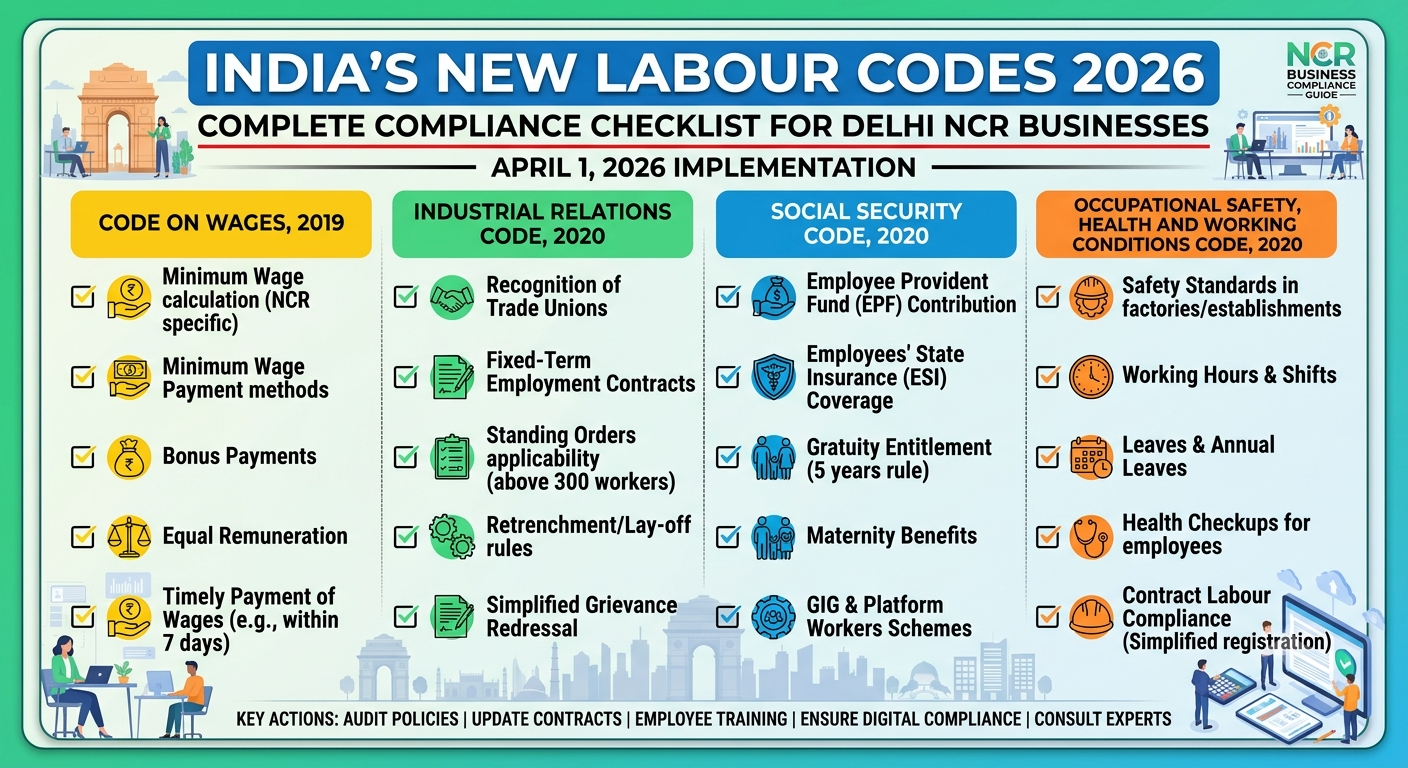
---# India's New Labour Codes 2026: Complete Compliance Checklist for Delhi NCR Businesses**Quick answer:** India has replaced 29 old labour laws with 4 unified Labour Codes — Wages, Industrial Relations, Social Security, and Occupational Safety. The codes were officially notified effective 21 November 2025, with full operational enforcement targeted for April 1, 2026, though states must separately notify their own rules. For Delhi NCR businesses, this means new payroll structures, revised PF/gratuity contributions, and mandatory digital compliance filings — starting now, not later.If you run a business in Delhi, Noida, Gurugram, Faridabad, or Ghaziabad, this guide breaks down exactly what has changed and what to do about it.## What Are the 4 New Labour Codes?India's labour reforms consolidate 29 existing central labour laws into four comprehensive codes, enacted between 2019 and 2020. Here's how they break down:| Code | Old Laws Replaced | What It Covers |
|---|---|---|
| Code on Wages, 2019 | Minimum Wages Act, Payment of Wages Act, and others | Uniform wage definition, minimum wage, timely payment |
| Industrial Relations Code, 2020 | Trade Unions Act, Industrial Disputes Act, Standing Orders Act | Hiring, fixed-term employment, unions, disputes |
| Code on Social Security, 2020 | EPF Act, ESI Act, Gratuity Act, Maternity Benefit Act, and others | PF, ESI, gratuity, gig/platform worker security |
| Occupational Safety, Health & Working Conditions Code, 2020 | Factories Act, Contract Labour Act, Inter-State Migrant Workmen Act | Workplace safety, working hours, migrant worker welfare |On 8 May 2026, the Ministry of Labour and Employment notified the central rules under all four codes, advancing their operationalisation — but these central rules apply only where the central government is the "appropriate government," so applicability varies by sector and establishment. Sectors like factories, plantations, and newspaper organisations will instead follow the relevant state government rules, which is exactly why Delhi NCR businesses need a state-specific compliance check rather than relying on generic national guidance.## The 50% Wage Rule: Why It Changes Your PayrollThis is the single biggest change employers are asking about. The new rule mandates that basic pay must comprise at least half of an employee's total CTC (cost to company). If allowances such as HRA or special allowance push basic pay below 50%, the excess amount is legally treated as "wages" for calculating PF and gratuity contributions.**Why this matters:** Employers have historically kept basic pay low specifically to reduce PF and gratuity liability, but the new wage code closes that gap — pushing up statutory costs like PF and gratuity by an estimated 5–15% for most employers.**What you must do:**
- Audit every employee's current CTC breakup against the 50% threshold
- Recalculate PF, ESI, and gratuity contributions on the revised wage base
- Update offer letters, appointment letters, and employment contracts
- Budget for the increased statutory cost across your workforce## Other Major Changes Delhi NCR Employers Must Track**1. Digital records are now mandatory.** Paper attendance registers, leave records, and appointment letters are no longer sufficient — all records including attendance, wages, leave, ESI/EPF documentation, appointment letters, and grievance registers must move to electronic systems.**2. Fixed-term employees get full benefit parity.** Fixed-term employees must now receive the same wages and benefits as permanent staff, including EPF, ESI, medical insurance, and leave — narrowing the cost advantage businesses once had by hiring on fixed-term contracts.**3. Contract labour threshold has risen.** The threshold for contract labour provisions increased from 20 to 50 workers, giving businesses more flexibility — but principal employers are now liable if a contractor fails to pay wages.**4. Faster full-and-final settlements.** Under the new rules, F&F settlements after resignation or termination must be completed within a tightly defined window, forcing HR and payroll teams toward real-time, automated processing rather than the following month's cycle.**5. Single registration, single licence.** The reforms aim to reduce multiplicity of compliance through single registration, an all-India single licence, electronic filings, and time-bound approvals — genuinely useful once systems catch up, but it also means old manual workarounds will no longer be accepted.## Compliance Action Timeline for 2026A practical, phase-wise approach recommended by compliance experts:- **Immediately:** Audit your current wage structure and model the financial impact of the 50% basic pay rule
- **This quarter:** Update payroll configurations, employment contracts, and offer letter templates
- **Next quarter:** Train HR and finance teams on the new framework; digitise all statutory registers
- **Ongoing:** Register on the unified compliance portal, update standing orders, and track your specific state's notification status, since implementation dates vary by state and compliance becomes immediately mandatory once a state notifies its final rules## State-Specific Compliance: Why "Delhi NCR" Isn't One RulebookThis is the part most national guides miss, and it's the part that matters most if you operate across the NCR. Delhi NCR is not a single jurisdiction — it spans **Delhi (a Union Territory), Haryana, and Uttar Pradesh**, and each state notifies its own rules under the four Labour Codes on its own timeline. A business with offices in Connaught Place, a warehouse in Gurugram, and a unit in Noida can legally be at three different stages of compliance at the same time.**Delhi (NCT of Delhi):**
- Falls under central government rules for establishments where the central government is the "appropriate government" (e.g., banking, insurance, ports, PSUs); all other establishments follow Delhi's own notified state rules
- Shops & Establishment registration, Delhi Shops and Establishments Act obligations, and Delhi-specific minimum wage notifications continue to run alongside the new codes until Delhi's rules are fully harmonised
- Businesses should track notifications from the Delhi Labour Department separately from central MoLE updates**Haryana (Gurugram, Faridabad):**
- Haryana has been among the more active states in notifying draft and final rules under the codes, particularly around the Wage Code and OSH Code
- Gurugram-based IT/ITES and corporate employers should pay close attention to Haryana's rules on working hours, women's night-shift provisions, and contract labour thresholds, which can differ from the central defaults
- Faridabad's manufacturing and factory establishments fall more heavily under the Occupational Safety, Health and Working Conditions Code and need factory-specific registration updates**Uttar Pradesh (Noida, Ghaziabad, Greater Noida):**
- UP has its own pace of rule notification, and Noida/Greater Noida's dense concentration of manufacturing units and IT parks means both OSH Code and Social Security Code provisions apply heavily
- Migrant worker provisions are especially relevant here, given the high proportion of interstate migrant labour in UP's industrial units
- Ghaziabad establishments should confirm whether UP's notified rules or the central rules govern their sector before restructuring payroll**The practical takeaway:** if your business has even two locations across Delhi, Haryana, and UP, a single compliance checklist won't work. You need parallel tracking — one wage/PF/gratuity policy that satisfies the strictest applicable state rule, plus location-specific registers, standing orders, and filings. This is precisely where most NCR businesses get caught out: not because they ignored the Labour Codes, but because they applied Delhi's rule to a Gurugram office, or a central-government exemption to an establishment that doesn't qualify for it.## What Happens If You Don't Comply?The cost of non-compliance — retrospective PF liabilities, gratuity shortfalls, and inspection penalties — is real and grows with every payroll cycle you run under the old structure. Unlike a one-time registration lapse, wage and PF non-compliance compounds month over month, making early correction far cheaper than a retrospective fix during an audit or inspection.## Frequently Asked Questions**Are the new Labour Codes applicable now, in 2026?**
Yes. The four Labour Codes were officially notified effective 21 November 2025, with full operational enforcement targeted for April 1, 2026. Since states must notify their own rules separately, the exact enforcement date can vary by state — if your state has already notified final rules, compliance is immediately mandatory.**What is the 50% wage rule under the Code on Wages?**
It requires that basic pay plus dearness allowance make up at least 50% of an employee's total CTC. Any allowance amount above that threshold is treated as "wages" for PF and gratuity calculation, which typically raises statutory contribution costs.**Do fixed-term employees get the same benefits as permanent employees?**
Yes — fixed-term employees must receive wages and benefits identical to permanent employees, including EPF, ESI, medical insurance, and leave.**Is Labour Law compliance mandatory for small businesses and MSMEs in Delhi NCR?**
Yes. Applicability thresholds vary by code and establishment size, but most registered businesses with employees — including MSMEs, factories, and shops under Shops & Establishment registration — fall within scope and need a compliance review specific to their state and sector.**Who should Delhi NCR businesses consult for Labour Code compliance?**
Given that central rules, state rules, and sector-specific applicability all interact differently, a local compliance consultant familiar with Delhi, Noida, Gurugram, Faridabad, and Ghaziabad requirements can conduct a wage audit and handle documentation, registration, and filings end-to-end.## Get Your Labour Code Compliance Audit DoneLegalEase Compliance (Shailputri Enterprises), based in Karam Pura, New Delhi, helps businesses across Delhi NCR navigate PF, ESI, gratuity, Shops & Establishment, and full labour law compliance — including CTC restructuring for the new 50% wage rule. With 10+ years of experience and 1000+ approvals across Delhi NCR, our team can audit your current payroll structure, flag gaps, and manage the transition with the correct authorities.📞 Call or WhatsApp: **+91-9818624442**
✉️ Email: **info@legaleasecompliance.co.in**
📍 Serving Delhi, Noida, Gurugram, Faridabad, Ghaziabad & Greater Noida*Disclaimer: This article is for general informational purposes and does not constitute legal advice. Labour Code applicability and state-level rules vary; consult a compliance professional for guidance specific to your business.*