

FSSAI Renewal Rules 2026: What Food Businesses Need to Know
The FSSAI Renewal Rules 2026 bring a major change to the way food businesses manage their FSSAI Registration and Licence in India.
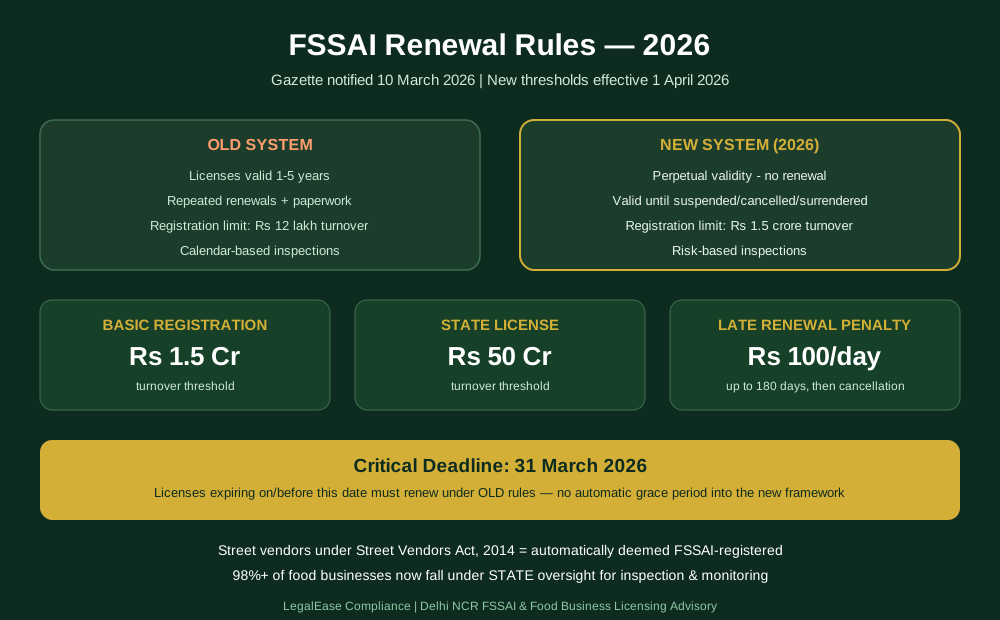
Under the amended framework, FSSAI has introduced perpetual validity for registrations and licences. This means Food Business Operators (FBOs) covered by the new framework are generally not required to renew their FSSAI Registration or Licence periodically. The registration or licence remains valid unless it is suspended, cancelled or surrendered.
At the same time, FSSAI has revised the turnover thresholds used to categorise food businesses into Registration, State Licence and Central Licence.
These revised thresholds came into effect from 1 April 2026.
For food businesses in Delhi, Noida, Gurugram, Ghaziabad, Faridabad and other parts of India, understanding these changes is important because an old licence category may need to be reviewed against the revised turnover structure.
What Are the FSSAI Renewal Rules 2026?
The FSSAI Renewal Rules 2026 are part of the Food Safety and Standards (Licensing and Registration of Food Businesses) Amendment Regulations, 2026.
The key reforms include:
- Perpetual validity of FSSAI Registrations and Licences
- Revised turnover thresholds
- Deemed registration for certain eligible street-food vendors
- Risk-based inspections
- Food-safety audit framework
- Migration provisions for existing FBOs
FSSAI’s official FAQ confirms these reforms.
The purpose is to reduce repetitive paperwork while continuing to maintain food-safety standards.
Is FSSAI Renewal Required in 2026?
For registrations and licences covered by the new perpetual-validity framework, periodic renewal is no longer required.
This is the biggest change introduced in 2026.
FSSAI states that perpetual validity means the Registration or Licence remains valid unless it is:
- Suspended
- Cancelled
- Surrendered
FBOs are therefore not required to renew their licences periodically under this framework. However, they must continue complying with applicable food-safety, hygiene and other statutory requirements.
Simple Example
Earlier:
FSSAI Licence → Validity period → Renewal → Payment → Continued validity
Under the new framework:
FSSAI Licence → Perpetual validity → Continue compliance
This does not mean that food businesses can ignore FSSAI compliance.
What Does Perpetual Validity Mean?
Perpetual validity means the FSSAI Registration or Licence does not automatically expire simply because a fixed validity period has ended.
However, the licence can still be subject to regulatory action.
For example, an FSSAI licence may be affected by:
- Suspension
- Cancellation
- Surrender
- Regulatory non-compliance
- Food-safety violations
- Incorrect or outdated information
Therefore, food businesses should continue monitoring their compliance status.
FSSAI Renewal Rules 2026 and the 31 March Deadline
A common question among Food Business Operators is:
“Do I have to renew my FSSAI licence before 31 March 2026?”
The answer depends on the status and applicability of the revised framework.
The 2026 reforms introduced perpetual validity, so businesses should not automatically assume that a traditional annual renewal deadline continues to apply to their FSSAI Registration or Licence.
The important date for the revised turnover thresholds is 1 April 2026.
Therefore, businesses should focus on:
- Checking their existing licence
- Reviewing turnover
- Checking the Kind of Business
- Confirming the applicable licence category
- Checking whether migration or modification is required
New FSSAI Turnover Limits From 1 April 2026
One of the most important parts of the 2026 reforms is the revised turnover categorisation.
| Category | Annual Turnover |
|---|---|
| FSSAI Registration | Up to ₹1.5 Crore |
| FSSAI State Licence | Above ₹1.5 Crore up to ₹50 Crore |
| FSSAI Central Licence | Above ₹50 Crore |
These thresholds became effective from 1 April 2026.
Example
A food business with annual turnover of ₹80 lakh may fall under the Registration threshold, subject to the applicable business category.
A business with turnover of ₹8 crore may fall under the State Licence threshold.
A business with turnover above ₹50 crore may fall under the Central Licence threshold.
Important: Turnover alone does not determine every licensing requirement. The applicable Kind of Business (KoB) and other regulatory criteria must also be considered.
Do Existing FSSAI Licences Need to Be Changed?
Existing FBOs should review their current licence against the revised turnover thresholds.
FSSAI’s 2026 FAQ states that existing FBOs will be provided sufficient time to migrate through FoSCoS to align with the revised turnover thresholds.
Therefore, existing businesses should:
Step 1
Check the current FSSAI Registration or Licence.
Step 2
Check the current annual turnover.
Step 3
Verify the Kind of Business.
Step 4
Compare the business with the revised 2026 thresholds.
Step 5
Check FoSCoS for applicable migration/modification requirements.
Do not create a completely new FSSAI application unnecessarily without first checking the status of the existing licence.
FSSAI Registration 2026
Under the revised turnover structure, Registration generally applies to eligible food businesses with turnover up to ₹1.5 crore, subject to applicable criteria.
Examples may include certain:
- Small food businesses
- Food retailers
- Small restaurants
- Food stalls
- Cottage food businesses
- Small food manufacturers
The exact requirement depends on the Kind of Business.
FSSAI State Licence 2026
The revised threshold for State Licence is:
Above ₹1.5 crore and up to ₹50 crore annual turnover, subject to applicable criteria.
This category can cover eligible:
- Restaurants
- Manufacturers
- Caterers
- Wholesalers
- Distributors
- Food storage businesses
- Other specified FBOs
FSSAI Central Licence 2026
The revised Central Licence turnover threshold is:
Above ₹50 crore annual turnover, subject to applicable criteria.
Central Licence requirements may also apply to certain businesses because of their specific nature or category, regardless of simply looking at turnover.
FSSAI Renewal Rules 2026: FoSCoS Process
Although periodic renewal has been replaced by perpetual validity under the revised framework, FoSCoS remains an important platform for FSSAI licensing and compliance services.
The official FoSCoS portal provides facilities including:
- New Licence / Registration
- Modification
- Application tracking
- Annual Return
- Other food-business compliance services
For businesses affected by revised turnover thresholds, FoSCoS may be used for the applicable migration or modification process.
How to Check Your Existing FSSAI Licence
Before taking any action, keep your FSSAI certificate available.
Check:
- FSSAI Registration/Licence number
- Business name
- Premises address
- Kind of Business
- Food products
- Current turnover
- Contact information
- Other licence details
Then compare this information with your current business operations.
If your actual business has changed, the existing FSSAI information may need to be modified.
FSSAI Licence Modification in 2026
Perpetual validity does not mean that all information can remain unchanged forever.
If important business details change, an FBO may need to update the licence through the applicable process.
Possible changes include:
- Business address
- Contact information
- Food products
- Business activity
- Manufacturing details
- Other licence information
Businesses should not continue with inaccurate information simply because their licence has perpetual validity.
FSSAI Renewal Rules 2026: Documents
The exact documents depend on the business category and Kind of Business.
Common documents can include:
Identity Documents
- PAN
- Aadhaar or other identity proof
- Authorisation documents
Business Documents
- Partnership Deed
- Certificate of Incorporation
- Company documents
- Proprietorship documents
- List of directors/partners, where applicable
Premises Documents
- Rent Agreement
- Lease Deed
- Ownership proof
- Electricity bill
- Address proof
Food Business Documents
Depending on the activity:
- Food product list
- Layout plan
- Manufacturing process
- Equipment details
- Water analysis report, where applicable
- Food safety management information
- Supporting declarations
The exact document checklist should always be confirmed against the applicable Kind of Business.
FSSAI Fees 2026
Because the 2026 framework changes the validity structure, businesses should distinguish between:
Government regulatory fees
and
Professional consultancy charges.
The applicable government fee can vary depending on the type of Registration/Licence and business activity.
Before making any payment, verify the current fee shown through the official FSSAI/FoSCoS process.
Is There Still an FSSAI Renewal Fee?
Under the perpetual-validity framework, periodic renewal of applicable registrations and licences is no longer required.
Therefore, businesses should not assume that the old recurring renewal-fee model continues in the same way.
However, other applicable regulatory fees, modification-related charges or statutory requirements may still apply depending on the situation.
FSSAI Renewal Rules 2026 for Restaurants
Restaurants should review their:
- FSSAI licence
- Annual turnover
- Kind of Business
- Premises
- Food products
- Hygiene compliance
- Food-safety records
If the restaurant’s turnover or business activity places it in a different category under the revised framework, the business should check the applicable migration or modification process.
FSSAI Renewal Rules 2026 for Manufacturers
Food manufacturers should conduct a detailed compliance review because manufacturing activities can involve additional requirements.
Review:
- Manufacturing premises
- Food products
- Production capacity
- Machinery
- Product categories
- Technical documents
- Hygiene systems
- Food-safety management
- Annual turnover
- Existing FSSAI category
A manufacturer should not rely solely on the turnover threshold without checking the applicable manufacturing category.
FSSAI Renewal Rules 2026 for Cloud Kitchens
Cloud kitchens should also review their FSSAI status.
Important areas include:
- Correct premises
- Correct Kind of Business
- Food products
- Food preparation activity
- Delivery model
- Hygiene
- Labelling where applicable
- Existing FSSAI Registration/Licence
Perpetual validity does not remove the need for food-safety compliance.
FSSAI Renewal Rules 2026 for Delhi NCR
Food businesses operating in Delhi NCR should review their FSSAI status under the 2026 framework.
Our compliance service areas include:
Delhi | Noida | Greater Noida | Gurugram | Ghaziabad | Faridabad
Businesses can review their FSSAI Registration or Licence, turnover category, documents and applicable FoSCoS process.
Common Mistakes to Avoid
Mistake 1: Assuming Every Licence Needs Renewal
The 2026 framework introduces perpetual validity for applicable registrations and licences.
Mistake 2: Using Old Turnover Limits
The revised thresholds became effective from 1 April 2026.
Mistake 3: Ignoring Kind of Business
Turnover is not the only consideration.
Mistake 4: Creating a New Application Without Checking the Existing Licence
Existing FBOs may have migration options through FoSCoS.
Mistake 5: Assuming Perpetual Validity Means Zero Compliance
Food safety and hygiene requirements continue.
FSSAI Compliance Checklist 2026
Use this checklist to review your business:
☑ Existing FSSAI certificate checked
☑ Licence number verified
☑ Business name verified
☑ Premises address verified
☑ Kind of Business checked
☑ Annual turnover reviewed
☑ Revised 2026 threshold checked
☑ Food products reviewed
☑ Modification requirements checked
☑ FoSCoS status checked
☑ Food hygiene compliance maintained
☑ Required records maintained
☑ Applicable annual returns completed
☑ Labelling requirements reviewed
☑ Inspection requirements understood
FSSAI Renewal Rules 2026: What Should Existing FBOs Do?
If you already have an FSSAI Registration or Licence, don’t panic because of the word “renewal.”
Instead, follow this simple process:
Check → Review → Verify → Migrate/Modify if Required → Maintain Compliance
Check
Review your existing FSSAI certificate.
Review
Check turnover and actual business activity.
Verify
Confirm the applicable category and Kind of Business.
Migrate or Modify
Follow the applicable FoSCoS process if required.
Maintain
Continue meeting food-safety and hygiene requirements.
Frequently Asked Questions
Do I need to renew my FSSAI licence in 2026?
Under the revised 2026 framework, applicable FSSAI registrations and licences have perpetual validity and do not require periodic renewal unless they are suspended, cancelled or surrendered.
What is perpetual validity in FSSAI?
It means the registration or licence remains valid unless suspended, cancelled or surrendered.
What are the new FSSAI turnover limits for 2026?
Registration is generally up to ₹1.5 crore, State Licence is above ₹1.5 crore up to ₹50 crore, and Central Licence is above ₹50 crore, effective from 1 April 2026.
Do existing FSSAI licences need migration?
Existing FBOs may need to align their category with the revised turnover thresholds. FSSAI states that sufficient time will be provided for migration through FoSCoS.
Is the 31 March deadline still applicable for FSSAI renewal?
The 2026 framework introduces perpetual validity, so businesses should not automatically treat 31 March as a routine renewal deadline. They should instead verify their current licence and applicable 2026 requirements.
Can an FSSAI licence still be cancelled?
Yes. Perpetual validity does not prevent suspension or cancellation.
Can I modify my FSSAI licence after 2026?
Yes. Where business information changes, the applicable modification process should be followed through the prescribed FSSAI/FoSCoS system.
Is FSSAI compliance still required after perpetual validity?
Yes. Businesses must continue complying with applicable food-safety, hygiene and other statutory requirements.
Where can I check FSSAI services?
The official FoSCoS platform provides FSSAI licensing and registration services, including modification and other compliance functions.
Conclusion
The FSSAI Renewal Rules 2026 represent a major shift from the traditional periodic renewal model.
The introduction of perpetual validity means eligible FSSAI Registrations and Licences no longer require routine periodic renewal. However, businesses must continue meeting food-safety and statutory requirements.
At the same time, the revised turnover thresholds effective from 1 April 2026 mean existing food businesses should review whether their current Registration or Licence category is still appropriate.
For every Food Business Operator, the practical approach is simple:
Check your existing FSSAI status → Review turnover → Verify Kind of Business → Check FoSCoS → Migrate or modify if required → Continue compliance.
For businesses in Delhi NCR, professional assistance can help with FSSAI Registration, Licence review, modification, FoSCoS applications and related compliance requirements.